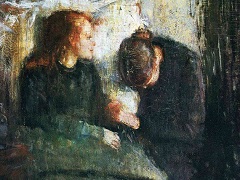
The Sick Child, 1885 by Edvard Munch
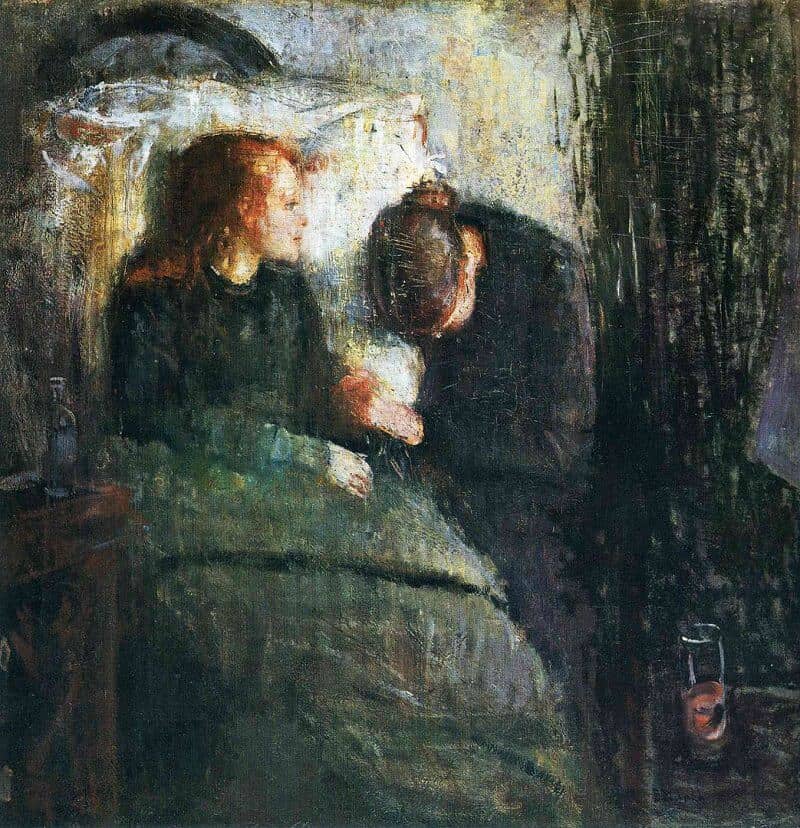
The Sick Child (Norwegian: Det Syke Barn) records a moment before the death of his older sister Johanne Sophie (1862 - 1877) from tuberculosis at 15. Munch returned to this deeply traumatic event again and again in his art, over six completed oil paintings and many studies in various media, over a period of more than 40 years. In the works, Sophie is typically shown on her deathbed accompanied by a dark-haired, grieving woman assumed to be her aunt Karen; the studies often show her in a cropped head shot. In all the painted versions Sophie is lying in a bed, obviously suffering from pain, propped by a large white pillow, looking towards an ominous curtain likely intended as a symbol of death. She is shown with a haunted expression, clutching hands with a grief-stricken older woman who seems to want to comfort her but whose head is bowed as if she cannot bear to look the younger girl in the eye.
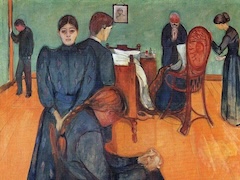
Throughout his career, Munch often returned to and created several variants of his paintings. The Sick Child became for Munch - who nearly died from tuberculosis himself as a child - a means to record both his feelings of despair and g uilt that he had been the one to survive and to confront his feelings of loss for his late sister. He became obsessive with the image, and during the decades that followed he created numerous versions in a variety of formats. The six painted works were executed over a period of more than 40 years, using a number of different models.